

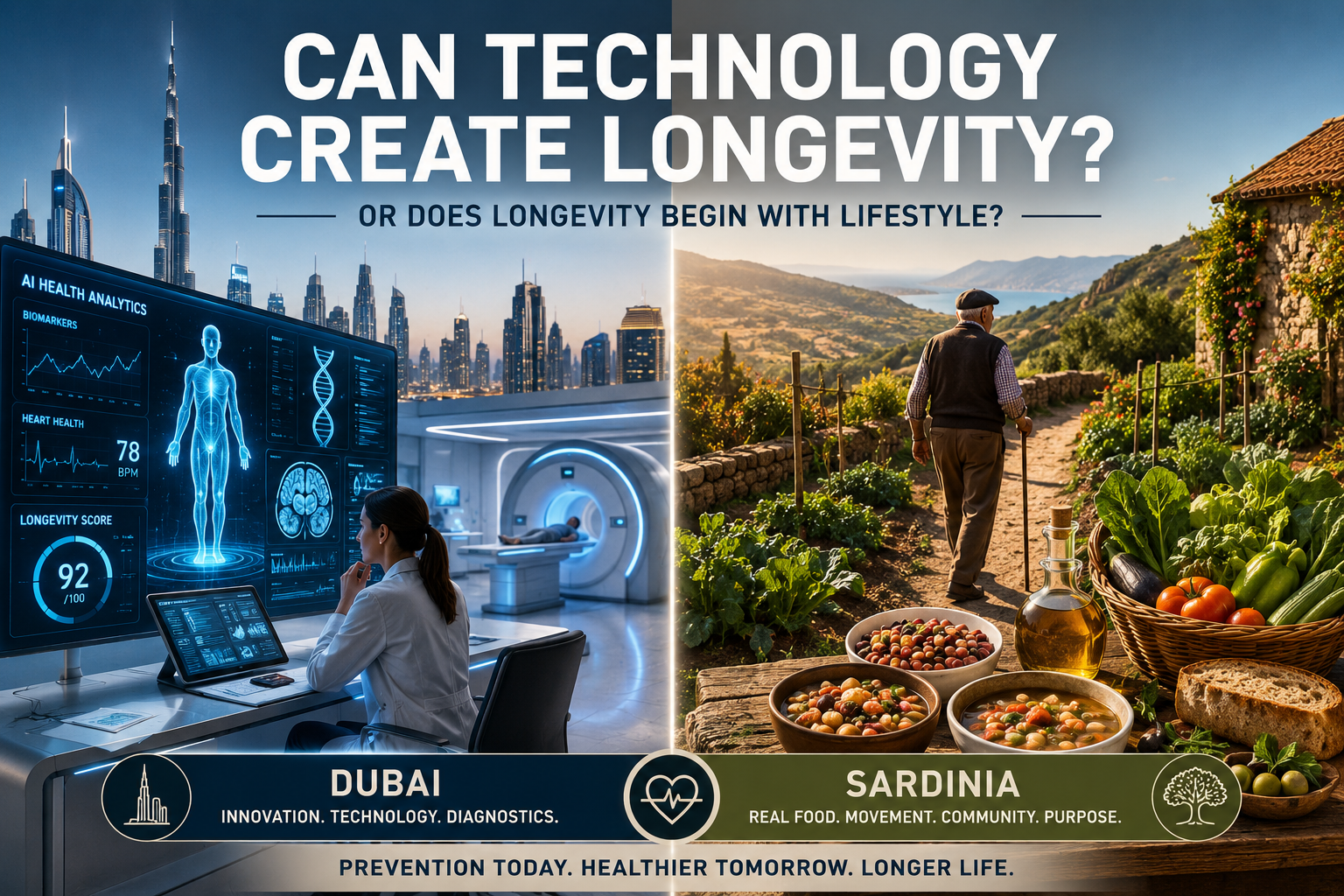
Sheikh Hamdan bin Mohammed bin Rashid Al Maktoum, has been appointed to lead the UAE’s new Longevity Authority.
The vision is ambitious.
There is talk of artificial intelligence, advanced diagnostics, genetic testing, personalised medicine and cutting-edge technology designed to help people live longer.
As someone born and raised in Sardinia, one of the world’s original Blue Zones, I find this fascinating.
But I also find myself asking a very simple question.
How is Dubai going to prevent illness in the first place?
Because that is the real challenge.
Technology can detect disease earlier. It can monitor health markers. It can identify risk factors.
But technology does not stop people from developing many of the diseases that are already affecting the UAE at alarming rates.
More than 75% of deaths in the UAE are linked to non-communicable diseases.
Heart disease and stroke remain among the leading causes of death.
Over one-third of adults are obese.
The UAE has one of the highest rates of Type 2 diabetes in the world.
These are not primarily technology problems.
They are lifestyle problems.
As a nutritional therapist, I have spent years studying why certain populations live longer than others.
The answer is rarely found in a laboratory.
It is found on the dinner table.
It is found in daily movement.
It is found in community.
It is found in purpose.
When I visit Dubai, I see a city that excels in innovation, luxury and beauty.
But sometimes I wonder whether health has become secondary to appearance.
Many people I speak to tell me they do not feel satisfied unless they eat meat at every meal.
Vegetables are often treated as a side dish rather than the foundation of the meal.
Yet when we look at the world’s longest-living populations, including Sardinia, we see something very different.
We see beans.
We see vegetables.
We see whole grains.
We see olive oil.
We see simple, traditional foods eaten consistently over a lifetime.
We see people walking every day without calling it exercise.
This is not a secret.
It is evidence-based longevity.
There is another issue that deserves attention.
The UAE has historically experienced high rates of consanguineous marriage, which has contributed to an increased prevalence of inherited conditions such as beta-thalassaemia and sickle-cell disease.
The introduction of premarital genomic screening is a positive step.
A healthy population requires us to address both genetic risks and lifestyle risks.
Both matter.
If Sheikh Hamdan genuinely wants to create one of the world’s healthiest and longest-living populations, nutrition education must sit alongside technology.
Children should learn how to grow food.
Schools should teach cooking skills.
Communities should be encouraged to move more.
Fresh, nourishing foods should become easier to access than ultra-processed alternatives.
Prevention must become the foundation, not an afterthought.
As someone born and raised in Sardinia, I would be delighted to contribute to that conversation.
After all, longevity is not something that can simply be scanned, tested or downloaded.
The world’s longest-lived populations teach us that longevity begins long before someone enters a clinic.
It begins with what is on the plate.
It begins with movement.
It begins with lifestyle.
And perhaps that is where the real longevity revolution should start.
Prevention rather than cure.
Milvia Pili
Functional Nutritional Therapist