
After 40, many women are unintentionally under fuelling their bodies.
Not because they are dieting aggressively.
But because they are busy, stressed, skipping meals, or still eating the way they did in their twenties.
The problem is that midlife physiology is different.
Muscle mass is more fragile. Stress tolerance shifts. Blood sugar regulation becomes more sensitive. Recovery takes longer.
Chronic under eating can quietly undermine metabolism, muscle, and hormonal balance.
So how do you know if you are not eating enough?
Here are some common signs.
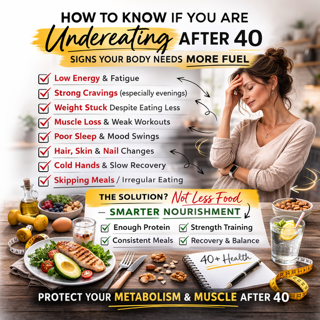
You feel tired most afternoons
Even with decent sleep, your energy drops and you rely on caffeine or sugar to push through.
You think about food constantly
Persistent food thoughts are often a biological signal, not a lack of willpower.
Your cravings feel intense
Especially in the evening. Restriction earlier in the day often drives this.
Your workouts feel harder than they should
You struggle to build strength or recover properly.
Your hair, skin, or nails have changed
Nutrient insufficiency often shows up here first.
You feel colder than others
Low energy availability can affect thyroid function and temperature regulation.
Your weight will not shift despite eating very little
The body adapts to chronic restriction by conserving energy.
You skip breakfast or delay meals regularly
Long gaps without nourishment increase stress hormones and destabilise blood sugar.
Undereating does not always look dramatic.
It can look like:
Coffee instead of breakfast
Salad with minimal protein
Skipping meals during busy days
Saving most calories for the evening
After 40, the body thrives on rhythm and adequacy.
Adequate protein.
Adequate total energy.
Consistent meal timing.
Strength training.
Recovery.
If several of these signs resonate, it may be time to assess your current intake honestly.
Eating less is not always the answer.
Sometimes the most powerful metabolic strategy is eating enough.
If you would like support reviewing your current patterns and building a personalised plan that protects muscle, stabilises blood sugar, and supports long term health, I invite you to book a consultation.
After 40, nourishment is strategic.
Warmly,
Milvia Pili
Functional Nutritional Therapy Practitioner