
The Food Pyramid Is Back in the Spotlight — But Are We Looking at the Right One?
The food pyramid is everywhere again.
Partly because it never really went away, and partly because of recent comments made by Donald Trump, which have reignited debate around dietary guidelines, carbohydrates, fats, and what we should be eating to stay healthy.
Once again, nutrition has become polarised.
One side argues the traditional food pyramid got it completely wrong.
Another wants to scrap it altogether.
And social media is filled with redesigned pyramids claiming to fix decades of mistakes.
But before we throw everything out or jump on the next trend, it’s worth asking a more grounded question:
What does a food pyramid look like when it’s based on real longevity, not politics or popularity?
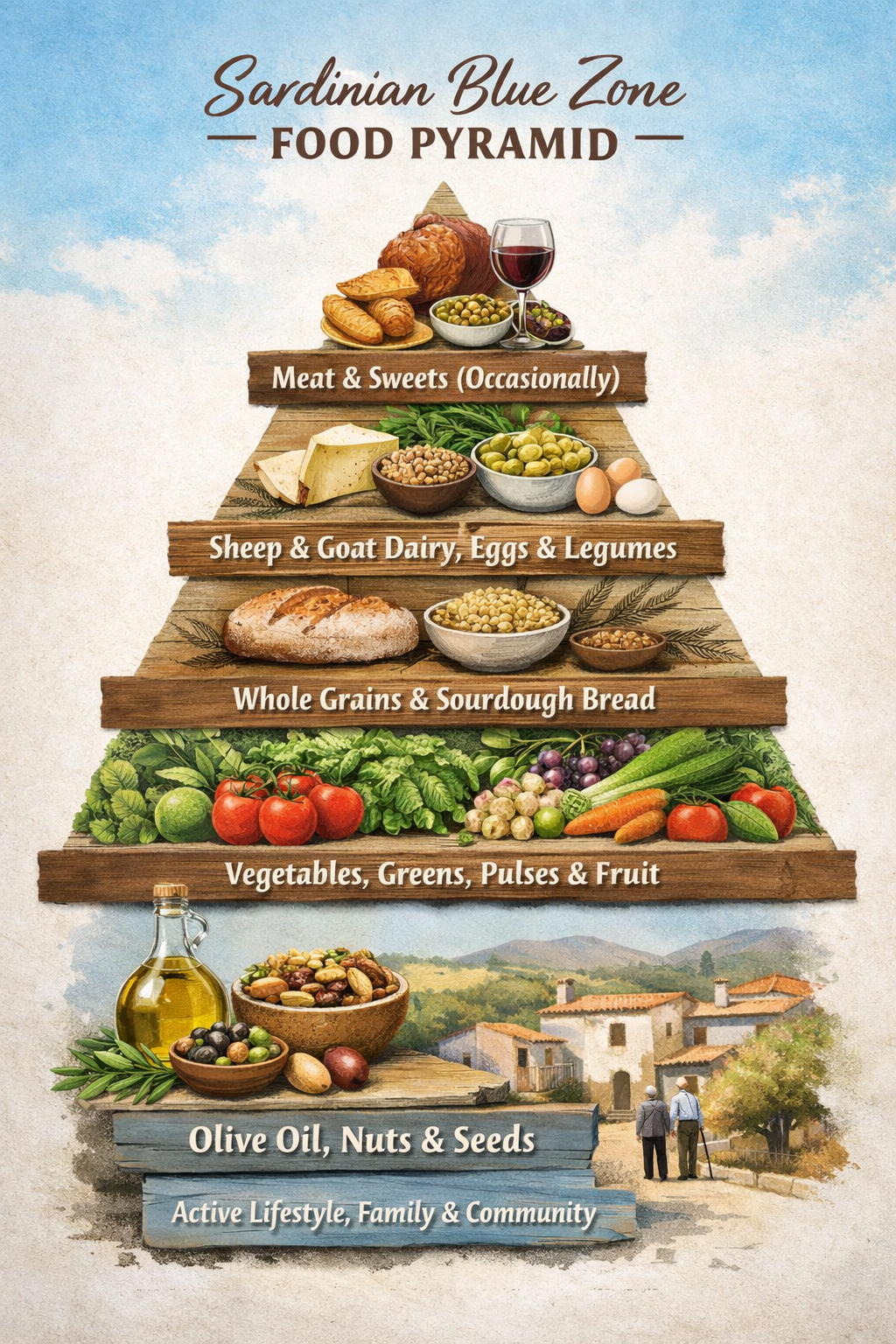
This is where the Sardinian Blue Zone food pyramid deserves attention.
Sardinia is one of the world’s longest-living regions, with exceptional rates of healthy ageing, low chronic disease, and remarkable vitality well into later life. Their way of eating was never designed by committees, corporations, or governments. It evolved naturally over generations.
At the base of the Sardinian pyramid are plant foods. Vegetables, wild greens, legumes, pulses, and seasonal produce form the backbone of daily meals. These foods support gut health, reduce inflammation, and help stabilise blood sugar — all critical after 40.
Above that sit traditional carbohydrates, not ultra-processed versions but whole grains like barley, beans, and sourdough bread. These are eaten with meals, alongside fibre and fat, not as isolated, refined products.
Protein is present, but modest. Legumes play a central role, alongside small amounts of eggs, sheep and goat dairy such as pecorino, and occasional meat. Meat is not the centrepiece of every meal — it is a complement.
Fats come naturally from olive oil, nuts, seeds, and dairy from animals raised traditionally. These fats support hormone health, brain function, and cardiovascular resilience.
What you won’t find dominating the Sardinian pyramid is ultra-processed food. No protein bars, packaged snacks, sweetened cereals, or industrial seed oils. These foods simply didn’t exist in the traditional diet — and their absence matters.
Importantly, the Sardinian pyramid does not stop at food.
Movement, daily walking, strong social ties, shared meals, purpose, and routine sit at the very foundation. Health is not reduced to nutrients alone.
While political debates may continue about whether the original food pyramid was right or wrong, the Sardinian model reminds us of something essential:
Longevity is not built on extremes.
It is built on consistency, simplicity, and tradition.
For those over 40, this approach offers something far more valuable than the latest viral pyramid — a way of eating that supports energy, balance, and long-term health without deprivation.
Before reacting to headlines or trending opinions, it may be worth looking not at who is talking the loudest, but at who has quietly been living well the longest.
Food for thought.
Warmly,
Milvia Pili, FNTP
Functional Nutritional Therapy Practitioner