

Dear reader,
Longevity isn’t only shaped by what you eat.
It is shaped by how safe your body feels — consistently, day after day.
After 40, the body becomes far more sensitive to unpredictability. Skipped meals, irregular eating times, inconsistent sleep, and cycles of restriction followed by overcompensation may appear harmless, or even disciplined. Physiologically, however, they register as stress.
And stressed bodies do not age well.
When the body cannot predict when the next meal is coming, or whether energy will be reliably available, it shifts into preservation mode. Stress hormones such as cortisol rise in order to protect blood sugar, preserve fuel, and maintain basic function. While this response is intelligent and protective in the short term, when it becomes chronic it comes at a cost.
Elevated stress hormones disrupt blood sugar balance, increase inflammation, impair sleep, and slow the very repair processes that support longevity and healthspan.
This is why so many people feel tired, wired, hungry, or stuck despite “doing all the right things.” The body isn’t failing. It is responding to uncertainty.
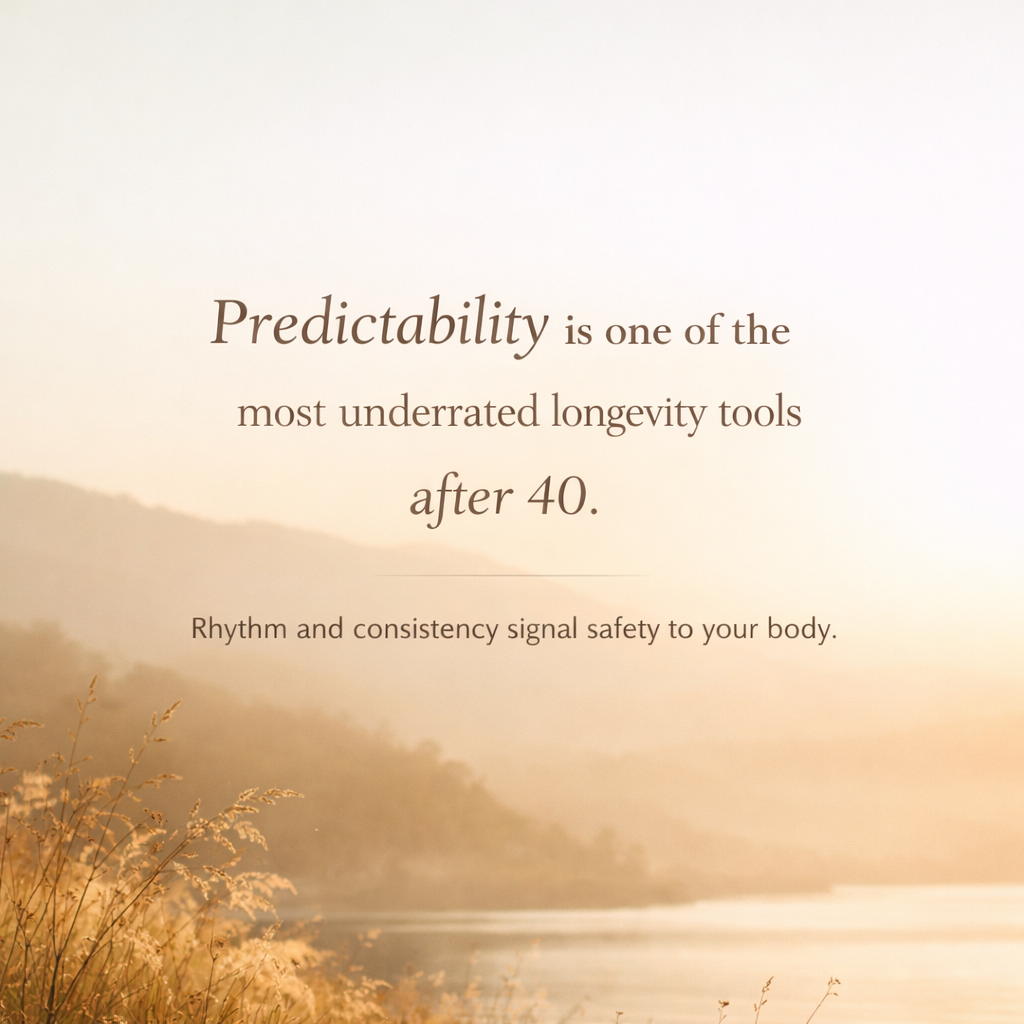
Predictability signals safety
One of the most powerful — and overlooked — signals of safety is predictability.
Regular meals.
Consistent nourishment.
Reliable rhythms.
When meals arrive at roughly the same times each day, and the body receives adequate energy without long gaps or deprivation, blood sugar stabilises. Stress hormones settle. Digestion improves. The nervous system downshifts from vigilance into repair.
In this state, the body can invest in long-term processes such as cellular repair, hormone balance, immune resilience, and metabolic flexibility — all essential components of healthy ageing.
What longevity cultures do differently
In longevity-focused regions of the world, extreme restriction and erratic eating patterns are notably absent. Meals are regular, social, and nourishing. There is an underlying rhythm to the day that provides the body with consistent signals of safety.
It is not perfection that supports longevity — it is reliability.
The body does not need constant optimisation.
It needs to trust that its basic needs will be met.
Longevity is built on steadiness, not strain
Predictability may not sound exciting or dramatic, but it is profoundly powerful. For many people, simply eating enough, eating consistently, and removing the stress of uncertainty can unlock more energy, better sleep, improved mood, and a gentler relationship with food.
Longevity is not created by pushing harder or demanding more discipline.
It is created by working with your biology, not against it.
If you’ve been feeling stuck, fatigued, or frustrated, this may be an invitation to stop striving — and start supporting.
Small, steady signals of safety compound over time.
And the body remembers.
If this feels like the approach your body has been asking for, you’re welcome to join the conversation inside my private group, where we explore longevity through nourishment, rhythm, and steadiness.
Warmly,
Milvia Pili
Functional Nutritional Therapy Practitioner