

Dear reader,
For many people, skipping meals feels harmless — even virtuous.
A late breakfast.
Pushing lunch a little further.
Ignoring hunger in the name of discipline, productivity, or control.
But after 40, the body interprets skipped meals very differently.
What feels like a small habit can quietly signal danger to your nervous system and metabolism — with real consequences for energy, hormones, blood sugar, and long-term health.
Your body doesn’t understand willpower
The human body does not recognise modern intentions like “I’m being good” or “I’ll eat later.”
It understands only patterns and signals.
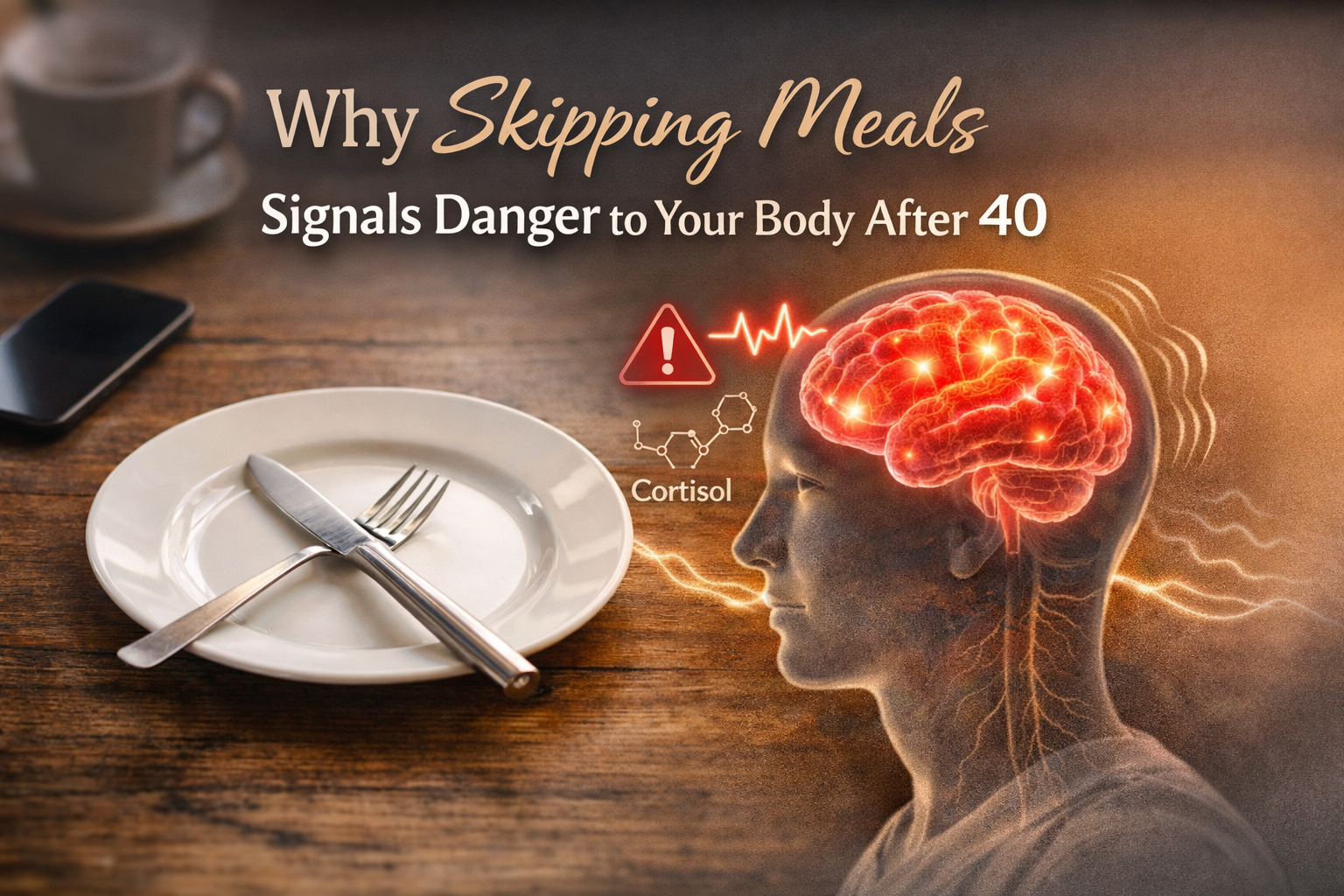
When meals are delayed or skipped, the body reads this as uncertainty around food availability. In response, stress hormones — particularly cortisol — rise to protect blood sugar and preserve energy.
In the short term, this response is protective.
Over time, however, repeated signals of scarcity place the body in a chronic state of vigilance.
The impact on blood sugar and ageing
When cortisol remains elevated:
- Blood sugar becomes harder to regulate
- Cravings and energy crashes increase
- Sleep quality declines
- Inflammation rises
- Muscle preservation becomes more difficult
All of these quietly undermine healthspan — the ability to live well, not just longer.
This is why many people feel tired, reactive, or stuck despite eating “well” or following the latest health advice. The body isn’t failing. It is responding intelligently to stress signals.
Why this matters more after 40
As we age, our ability to buffer stress decreases. Hormonal shifts, changes in muscle mass, and altered insulin sensitivity mean the body is less forgiving of irregular nourishment.
What might have worked in your 20s or 30s can now lead to fatigue, stubborn weight, poor sleep, and slower recovery.
Skipping meals doesn’t create balance.
It creates uncertainty.
Longevity thrives on consistency
In longevity-rich cultures, meals are regular, nourishing, and predictable. The body learns to trust that energy will arrive consistently, allowing stress hormones to settle and repair processes to resume.
Predictable nourishment is one of the simplest ways to:
- Stabilise blood sugar
- Reduce physiological stress
- Support metabolic health
- Protect long-term resilience
Longevity is not built through restriction.
It is built through steady signals of safety.
A gentler way forward
This isn’t about eating more or eating perfectly.
It’s about eating consistently.
Small, regular meals.
Listening to early hunger cues.
Removing the stress of uncertainty.
These simple shifts often unlock more energy, better sleep, calmer digestion, and a more trusting relationship with your body
If this perspective resonates, you’re welcome to explore more reflections like this inside my private community, where we talk about longevity through nourishment, rhythm, and steadiness.
Warmly,
Milvia Pili
Functional Nutritional Therapy Practitioner