

When we talk about blood sugar, most conversations focus on food.
Sugar intake.
Carbohydrates.
Meal timing.
But after 40, one of the most powerful drivers of blood sugar instability is not just what you eat.
It is stress.
Stress is not only emotional. It is physiological.
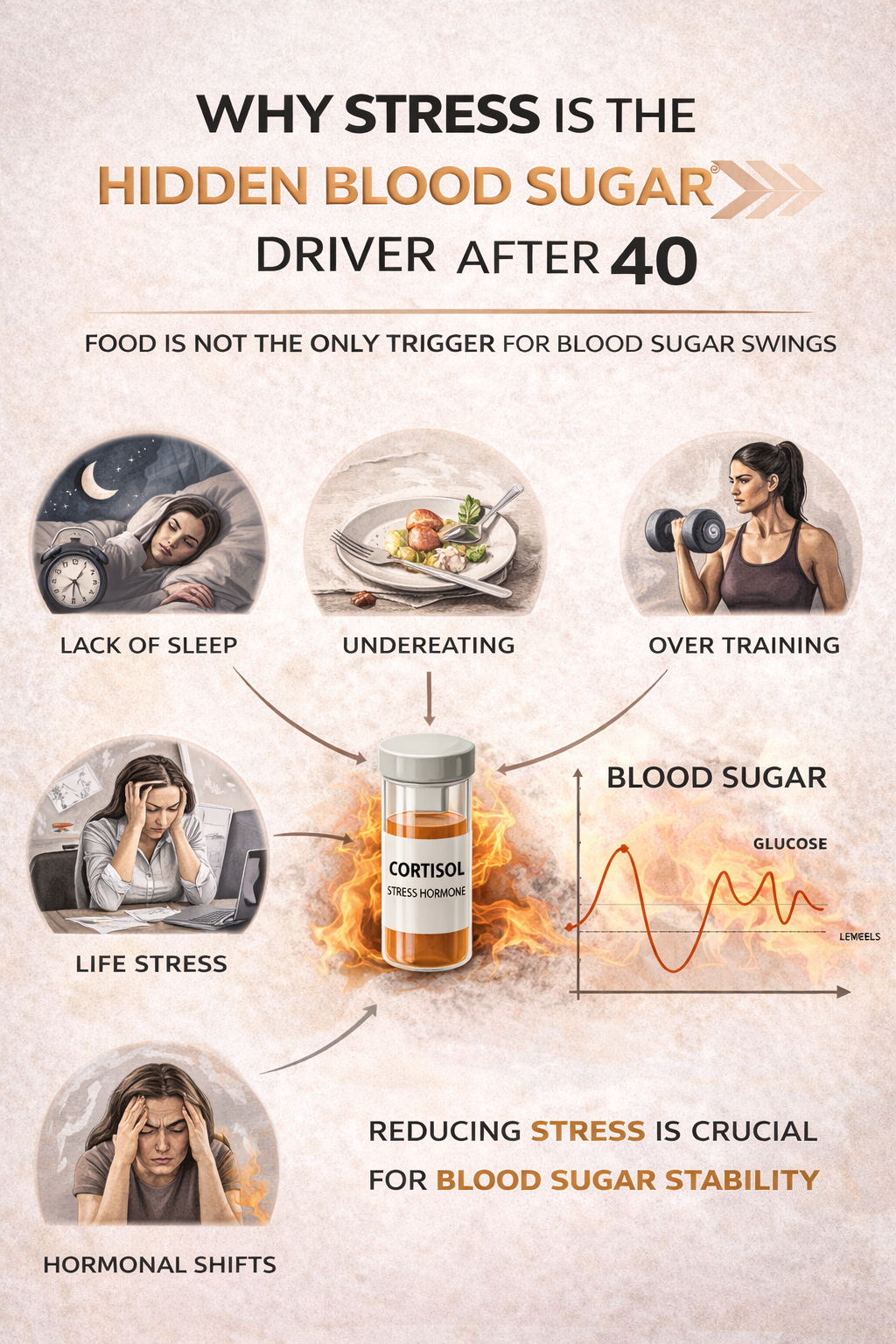
Lack of sleep.
Undereating.
Over training.
Work pressure.
Hormonal shifts.
All of these activate the same stress response.
When your body perceives stress, it releases cortisol and other stress hormones. Cortisol’s job is to keep you safe. One of the ways it does this is by increasing glucose in the bloodstream so you have quick access to energy.
In short bursts, this is helpful.
But when stress becomes chronic, blood sugar can remain elevated or swing more dramatically.
Over time, this may contribute to:
Increased cravings
Energy crashes
Greater fat storage, particularly around the abdomen
Reduced insulin sensitivity
Poor sleep, which further worsens the cycle
After 40, this system becomes more sensitive.
Muscle mass may already be declining. Hormonal fluctuations can amplify stress reactivity. Recovery capacity is not the same as it was at 25.
This means the same lifestyle habits that once worked can now destabilise blood sugar.
Skipping meals may increase cortisol.
Over training without adequate fuel may increase cortisol.
Sleeping five hours a night may increase cortisol.
It is not only about carbohydrates.
It is about the total stress load.
Supporting blood sugar after 40 requires a broader lens.
Consistent meals that signal safety.
Adequate protein to protect muscle.
Strength training with sufficient recovery.
Prioritising sleep.
Building stress management practices that are realistic and sustainable.
Blood sugar stability is not created by restriction alone.
It is created by reducing unnecessary stress on the system.
If your blood sugar feels unpredictable, your energy inconsistent, or your cravings stronger than they used to be, it may be time to look beyond food and assess your overall stress load.
If you would like support reviewing your current lifestyle and building a personalised plan that protects muscle, stabilises blood sugar, and reduces metabolic stress, I invite you to book a consultation.
After 40, resilience is built through protection, not pressure.
Warmly,
Milvia Pili
Functional Nutritional Therapy Practitioner