

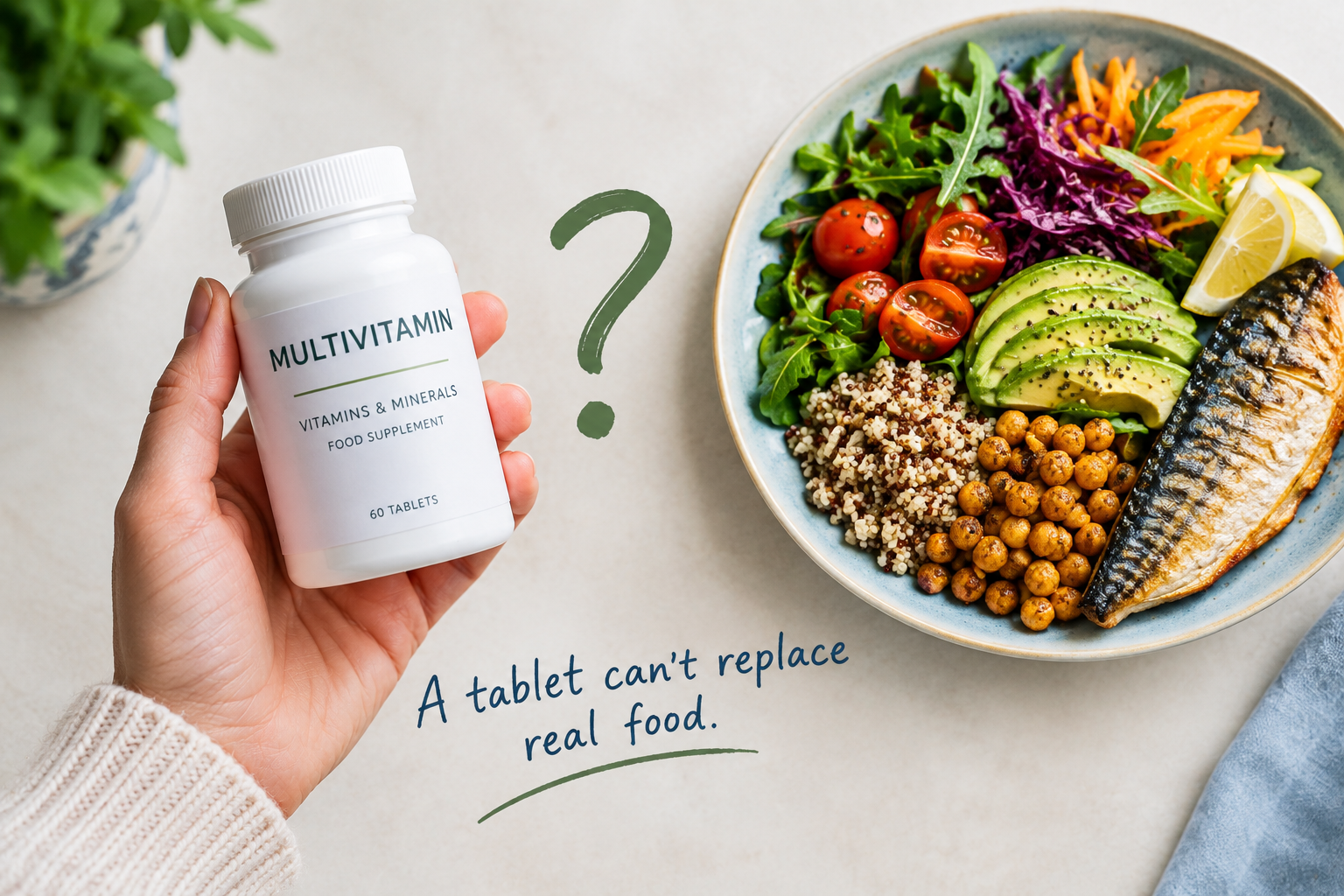
A lot of people tell me the same thing when we start working together. “I take a multivitamin, so I’ve got that side covered.” It’s one of the most common assumptions I come across, and it’s rarely true in the way people think.
I want to be clear from the start. This isn’t an argument against supplements. The issue isn’t supplements existing. It’s what people believe a generic multivitamin is actually doing for them.
Take me, for example. A standard multivitamin wouldn’t work for my own body. I process B12 very easily, to the point where a generic multivitamin would push me into an excess rather than a top-up, which isn’t good for me either. I also need vitamin D year-round, at a level a standard multivitamin doesn’t provide. My own supplement needs are specific to me, and a one-size-fits-all tablet simply wouldn’t cover them properly, it might even work against me.
Here’s what a standard multivitamin usually can’t do.
It can’t correct a specific deficiency it wasn’t designed to address. Multivitamins are built around general population guidelines, not your actual levels of anything. If you’re genuinely low in vitamin D, or iron, or B12, a small standardised dose in a multivitamin often isn’t enough to correct it, it’s enough to avoid the most extreme deficiency, which is a different target entirely.
It can’t fix poor absorption. Taking a nutrient and absorbing it are two different things. Gut health, certain medications, age, and stomach acid levels all affect how much of what’s in that tablet actually gets used by your body. Swallowing the pill isn’t the same as your body receiving the nutrient.
It can’t replace the form your body uses best. Many nutrients exist in several forms, and the cheaper, more common form used in mass-market multivitamins isn’t always the one your body converts and uses efficiently. This varies by nutrient and sometimes by person.
And it can’t tell you what you actually need, because it was never tailored to you in the first place. A multivitamin is a generalised product, built for an average that doesn’t actually exist. It’s not assessing your bloodwork, your diet, your health history, or your specific gaps. It’s a flat dose, identical for everyone who buys the same bottle.
This matters more as we age. Nutrient needs shift over the decades, absorption tends to decline, and the margin for “good enough” narrows. What covered the basics in your thirties may not be doing nearly enough in your fifties or sixties, and a generic multivitamin has no way of adjusting for that.
None of this means supplements are pointless. It means a multivitamin, taken without any real assessment of what you actually need, is often giving people a false sense of security rather than an actual solution. People stop looking at their diet and their specific gaps because they assume the tablet has it handled.
This is exactly the kind of thing I check properly with clients, what you actually need, in what form, and whether it’s something a supplement should even be solving, or whether the real answer is in what’s on your plate.
If you’ve been relying on a multivitamin and you’re not sure it’s doing what you think it is, get in touch and let’s find out properly.
Prevention rather than cure.
Milvia Pili
Functional Nutritional Therapist